Washing machine repair services
Washing machine installation and plumbing-in
Washing machine installation done properly means the transit bolts are out, the water and drain connections suit the machine, it stands level and a test run proves it all works. That goes for new machines, second-hand ones and machines moving house with you.
- Quote before any work starts
- R300 call-out, only if you decline the quote
- 6-month warranty on parts and labour
On this page
- What a proper installation involves
- Transit bolts: the step that matters most
- Water connections: hot, cold and pressure
- Getting the drain right
- Levelling and where the machine stands
- Under a counter, stacked or built in
- The plug and the socket
- No tap or drain point yet?
- Moving house with your washing machine
- Problems after an installation
What a proper installation involves
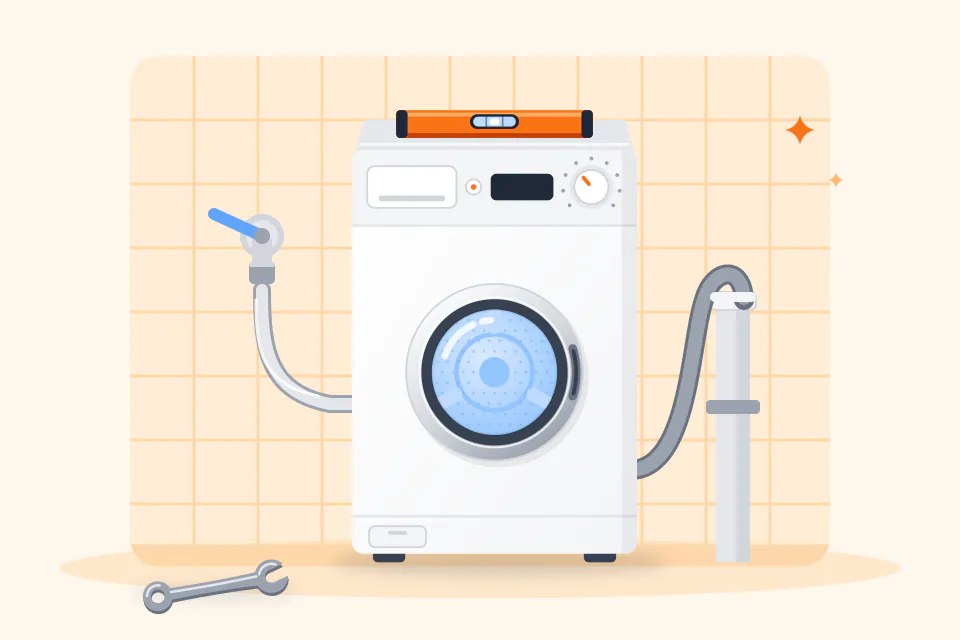
Plumbing-in a washing machine means connecting it to a water tap and a drain point, and getting the rest of the set-up right around those connections. A careful installation runs in this order:
- Unpack and inspect. The machine is checked for transport damage, and the packing and accessories come out, including any hoses, caps and brackets packed inside the drum.
- Remove the transit bolts. On a front loader, the bolts that lock the tub for delivery come out of the back panel, the holes are covered with the caps supplied, and the bolts are kept for the next move.
- Connect the water. The inlet hose goes onto the washing machine tap with its rubber washer seated properly, is tightened firmly by hand and checked for drips.
- Set up the drain. The drain hose goes into the standpipe or onto the sink trap at the height the manual gives, held in shape by its hose guide.
- Level the machine. The feet are adjusted until the machine is level from side to side and front to back, then locked so they can't creep.
- Test run. A short programme checks that the machine fills, drains and spins, with no leaks at the tap, the back of the machine or the drain.
Transit bolts: the step that matters most
Transit bolts stop the tub swinging around inside the cabinet while the machine is carried and driven. A front loader has several, with their heads showing on the back panel, and the installation section of the manual shows exactly where they are.
Running a machine with them still fitted makes it shake violently on the first spin and can damage the bearings, the suspension and the tub. If a newly delivered machine is jumping around, switch it off and check the back panel before anything else. Top loaders have transit packing too, which can be bolts, brackets or foam in the base depending on the model, and the manual lists everything that has to come out before the first wash.
Water connections: hot, cold and pressure
Many front loaders have a single inlet and heat their own water, so they connect to the cold supply only. Machines with two inlets, more common on top loaders, take both hot and cold, and the inlets are usually marked or colour-coded. Hoses connected the wrong way round give you cold washes when you've chosen hot, or hot water on a cold programme.
Use the new hoses that come with the machine rather than the old ones, because rubber hoses and their washers perish with age. If the hot tap is a long way from the geyser, the first water to arrive can be cold, which matters on a machine that takes a short hot fill. Your manual also gives the water pressure range the machine needs, and a supply outside that range can cause slow filling or errors.
Getting the drain right
The drain hose usually goes into a standpipe in the wall or onto the spigot of the trap under a kitchen sink. Either way, it has to sit within the height range given in your manual: high enough to stop the machine siphoning, and low enough for the pump to lift the water out.
If the hose sits too low, or is pushed too far down the standpipe, water can run out as fast as it comes in. The machine then fills and drains at the same time, washes poorly and may show an error. The hose shouldn't be sealed tightly into the pipe either: a small air gap around it stops a siphon forming and lets the water fall away freely.
Tip: a drain hose hooked loosely over the edge of a sink or bath can jump out when the pump pushes hard and flood the floor. If that's your only option for now, tie the hose securely so it can't slip.
Levelling and where the machine stands
A level machine is quieter, vibrates less and puts less strain on its suspension and bearings. On most machines the feet screw in and out, with a lock nut to hold them once they're set. When the machine is level, press down on opposite corners: it shouldn't rock at all.
Stand the machine on a solid, flat floor rather than carpet, loose tiles or a hollow wooden platform, which can flex and let it walk. If the floor slopes towards a floor drain, as many laundry floors do, the feet can take up a slight slope but not a steep one.
Under a counter, stacked or built in
Front loaders fit under a kitchen counter, provided there's enough height and a little space at the sides and back for the hoses, the cable and air. A top loader's lid opens upwards, so it needs open space overhead and can't stand under a counter.
A tumble dryer can usually go on top of a front loader using a stacking kit made for that pair, which stops the dryer moving during the spin. Don't stack a dryer on a top loader, or a washing machine on top of a dryer. Integrated machines are built into a kitchen unit behind a matching cabinet door, so the size of the unit and the hinge positions have to match the machine's installation instructions.
The plug and the socket
Plug the machine straight into a wall socket rather than an extension lead or multi-plug, and choose a socket you can reach without pulling the machine out, so switching off at the wall is easy. Keep the cable clear of the feet and away from anywhere it could be squashed behind the machine. If there's no suitable socket, adding one is a job for a registered electrician.
No tap or drain point yet?
An installation connects the machine to a washing machine tap and a drain point. If the spot you've chosen has neither, or they're out of reach of the hoses, describe the space when you book, and a photo helps. That way you know what the job involves before anyone comes out.
Moving house with your washing machine
- Run a drain or spin programme to empty the machine, then switch off at the wall, unplug it and close the tap.
- Let out the last of the water through the pump filter as your manual describes, with towels and a shallow tray ready.
- Disconnect the inlet hose from the tap and unhook the drain hose, let both empty into a bucket, then secure them for the move.
- Refit the transit bolts on a front loader, following the manual. If you've lost them, replacements can be ordered using the model number.
- Move the machine upright and strap it in so it can't tip over, rather than laying it on its back or front. It's too heavy to lift safely on your own, so use two people or an appliance trolley.
At the new home, the machine needs the same care as a new installation: transit bolts out, connected to the tap and drain, levelled and tested. The drain set-up in particular is often different from the old house, so it's worth checking rather than assuming.
Problems after an installation
If a newly installed or moved machine starts leaking, shaking on the spin or not draining, check the installation first. Transit bolts, hose washers, the drain hose height and the levelling feet are the first things to look at.
Installation is quoted before any work starts, like every job, and you can book a washing machine installation by phone, WhatsApp or the contact form. The call-out fee is R300, only payable if you decide not to go ahead with the quote. If you're still choosing a machine, our front loader vs top loader guide may help, while our cost guide covers what goes into a price.
Four simple steps
How it works
-
Contact us
Call or WhatsApp with your machine brand and what it is doing. A photo of the error code helps.
-
A technician comes out
We book a time that suits you, and on urgent call-outs we aim to arrive within 1 hour, depending on where the technician is working.
-
Diagnose and quote
We find the fault and give you a clear price before any work. The R300 call-out fee is only payable if you decide not to go ahead with the quote.
-
Repair
Most repairs are done on the spot when the part is available, and every repair carries our 6-month warranty.
More services
Other services
- Front loader repairs Bearings, pumps, door locks, seals, brushes and control boards on front loading machines.
- Top loader repairs Lid switches, belts, clutches, gearboxes, pumps and suspension on top loading machines.
- Washer-dryer repairs Drying heaters, fans, condensers and sensors, plus the washing faults, on combo machines.
- Servicing and maintenance A full check of filters, hoses, seals, bearings and brushes to catch problems early.
- Parts replacement Pumps, motors, bearings, door seals, boards, heating elements and more, fitted at your home.
Questions and answers
Installation and plumbing-in: questions we get asked
Do I need a plumber to install a washing machine?
What are transit bolts and do I have to remove them?
Can a washing machine and a dishwasher share a tap and drain?
Can I reuse the hoses from my old machine?
Why does my new machine keep filling and draining at the same time?
Can a tumble dryer go on top of my washing machine?
Should I run an empty wash before the first load?
Can my washing machine stand outside or in a garage?
Book a technician
Washing machine broken? Let's get it fixed.
Call or WhatsApp now and we'll book a technician to come to you. You'll get a quote before any work starts.