Washing machine repair services
Washing machine parts replacement
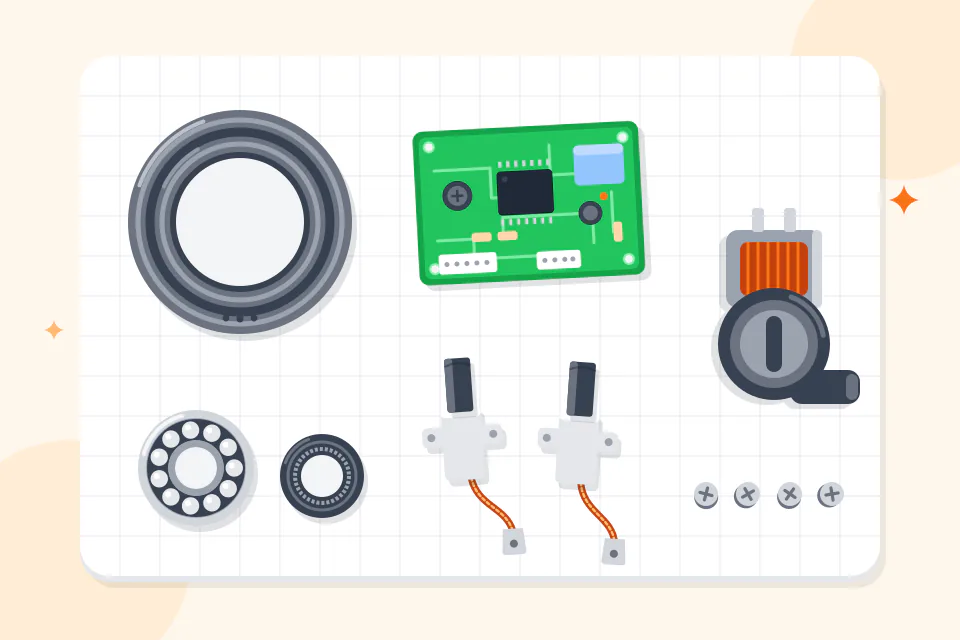
Washing machine parts replacement is how most faults are fixed: confirm which part has failed, fit the right one for your model and test the machine properly. Below are the parts that commonly wear or fail, the signs of trouble and what replacing each one involves.
- Quote before any work starts
- R300 call-out, only if you decline the quote
- 6-month warranty on parts and labour
On this page
Diagnosis comes first
Many faults look alike from the outside: a machine that won't spin could have worn brushes, a broken belt, a faulty speed sensor or a motor fault. Fitting the wrong part costs money without fixing anything, so parts are tested first and matched to the exact model number, because parts that look the same can differ between models of one brand. Have that number ready when you book a parts replacement.
Safety first: most of these parts sit inside the cabinet, next to mains wiring and water, so please don't try to fit them yourself. Switch off at the wall and leave the work to a technician.
Drainage and water parts
Drain pump and filter
What it does: pumps the water out before each spin, through a filter (sometimes called the coin trap) that catches coins, buttons and hair clips. On most front loaders the filter sits behind a flap at the bottom front, with the pump right behind it.
Signs it has failed: water left in the drum, a drain error, or a hum or grinding with no water moving.
What replacing it involves: the machine is drained, the pump is reached from the front, base or back, and the hoses and wiring are moved across. Sometimes a coin or an underwire is jamming it, and clearing it is enough. Related: a machine that won't drain.
Inlet valve
What it does: an electric valve where the hose meets the machine, opening to let water in when the control board calls for it. Many have two or three outlets feeding different parts of the detergent drawer.
Signs it has failed: no fill or a slow fill, a water supply error, detergent left in one compartment, or water trickling in with the machine off. If that happens, close the tap.
What replacing it involves: on most front loaders the top panel comes off, the hoses and connectors are moved to the new valve, and the joints are checked for leaks. Related: washing machine not filling with water.
Drive and drum parts
Motor and carbon brushes
What they do: the motor turns the drum. Many machines use a brushed motor, fed by two spring-loaded carbon brushes that wear down a little with every wash. Others use a brushless inverter motor, on a belt or mounted directly on the drum shaft, and many older designs and top loaders use an induction motor.
Signs of failure: the drum turns slowly, jerks or won't reach spin speed, there's a burning smell or sparking, or the power trips when the motor starts.
What replacing them involves: worn brushes are replaced as a pair, and the commutator they run on is checked for wear. A motor is only condemned once testing has ruled out the brushes, belt and speed sensor, then it's unbolted, replaced and run at full spin. Related: washing machine not spinning.
Drive belt
What it does: on a belt drive machine, carries the motor's power to the pulley on the drum or, on many top loaders, to the gearbox or clutch.
Signs it has failed: the drum or agitator won't turn although the motor runs, the drum slips under load, a squeal or a smell of hot rubber, or a belt lying off its pulley.
What replacing it involves: a quick job once the back or base panel is off. A belt that keeps coming off points to a loose pulley, a shifted motor or worn bearings letting the drum drop, so those are checked first.
Drum bearings and shaft seal
What they do: two bearings at the back of the outer tub carry the drum shaft and the weight of the wet washing, and a shaft seal stops water reaching them.
Signs they have failed: a rumble on the spin that grows into a roar, a drum that feels rough or has play, or drips under the middle of the machine. See signs of worn washing machine bearings.
What replacing them involves: the biggest routine repair. The machine is dismantled down to the tub, the tub halves are separated, new bearings and a seal are pressed in, and the shaft and drum spider are checked for corrosion. On a welded tub, the whole tub and drum assembly is replaced instead.
Shock absorbers and suspension
What they do: on a front loader, springs hold the tub from above and shock absorbers damp it from below. Many top loaders hang the tub on suspension rods.
Signs they have failed: banging on the spin, a machine that walks, a tub that bounces freely when pushed, or unbalanced errors with ordinary loads.
What replacing them involves: the old units are unclipped or unbolted top and bottom and new ones fitted, with the counterweight bolts checked at the same time. Related: washing machine noisy when spinning.
Door parts
Door seal
What it does: the rubber gasket that joins the front of the cabinet to the mouth of the tub on a front loader, keeping the water in while the tub moves.
Signs it has failed: water at the front during the wash, splits or holes (often low down), hardened rubber, or mould that won't wipe away.
What replacing it involves: the seal is held by one clamping band at the cabinet front and another around the tub, and some models need the front panel off. The new seal is lined up by its alignment marks, with its drain holes at the bottom, and tested for leaks. Related: washing machine leaking.
Door lock
What it does: locks the door during the wash and tells the control board it's shut, so the machine can start.
Signs it has failed: the machine clicks but won't start, the door stays locked after the cycle, a door error appears, or the wash stops part-way.
What replacing it involves: on many front loaders, the outer band of the door seal is eased off to reach the lock. The new lock is tested, and the catch, handle and hinges are checked too. Related: washing machine door won't open.
Electronic and heating parts
Control board (PCB)
What it does: runs the programmes and switches the motor, pump, valves and heater, often with a separate display board at the front.
Signs it has failed: a dead or unresponsive machine, programmes that stop or skip steps, random codes, or parts that won't switch on although they test fine. Faults often follow a surge when the power comes back after an outage.
What replacing it involves: the board is the last part to blame, so the parts it controls, the wiring and the mains filter are tested first. Boards are specific to the model, and some have to be set up for the machine once fitted. Related: washing machine won't turn on.
Heating element
What it does: heats the water in the bottom of a front loader's tub, with a temperature sensor reporting to the board. Many top loaders have none and use hot water from the geyser.
Signs it has failed: cold washes, a cycle that stalls while heating, a heating error, or the earth leakage tripping when the heat comes on.
What replacing it involves: the element is drawn out of its seal in the tub through the front or back panel, replaced and tested for leakage to earth. It's technician work only, so if the machine trips the power, leave it switched off at the wall.
Other parts we replace
- Lid switches and lid locks on top loaders, when the machine won't spin with the lid shut and the tub empty.
- Detergent drawers and softener siphon caps, when powder or softener is left behind.
- Pressure, temperature and speed sensors, whose faults can look like a board or motor problem and often show as an error code.
- Couplings, clutches and gearboxes on top loaders, when the motor runs but the agitator or drum doesn't turn.
- Inlet, drain and internal sump hoses, when one has split, perished or blocked.
- Door handles, hinges, catches and door glass, when the door won't close or latch properly, or the glass is cracked.
- Drum paddles and drum spiders, when a paddle has come loose or the spider that carries the drum has cracked or corroded.
- Mains filters, where the power cable enters the machine, when a surge has left the machine dead.
- Drying heaters, fans and thermostats on washer-dryers, when the machine washes but won't dry.
Original and compatible parts
Original parts, also called genuine or OEM parts, are made by or for the manufacturer and carry its part number. Compatible parts, also called pattern parts, are made by other companies to fit the same machines, and their quality varies: some match the original and some don't.
For simple wear parts such as drain pumps, belts, carbon brushes and shock absorbers, a good compatible part is often a sensible choice. For control boards, and for safety parts like door locks, an exact match matters more, and the original is often the safer option. Either way, the part has to match the model number, not just the brand.
If your machine is still under the manufacturer's warranty, contact the manufacturer first, because an outside repair or a non-original part may affect that cover. When you get a quote, it's fair to ask which kind of part is quoted, whether the other kind is available, and how the two compare.
Availability, cost and warranty
If the part is available, most repairs are finished on the same visit. If it has to be ordered, the technician tells you before you agree to the repair, and it's fitted and tested on a second visit.
The price depends mostly on the part, from a pair of brushes to a control board or a tub assembly, and on the labour needed to reach it. The call-out fee is R300, only payable if you decide not to go ahead with the quote. Every repair carries a 6-month warranty on parts and labour. The page on repair costs explains pricing, and our repair or replace guide helps when a major part fails on an older machine.
Fault guides
Problems this service fixes
- Washing machine not draining Water left in the drum, or a cycle that stops before the spin.
- Washing machine leaking Puddles under the machine, at the door or behind it.
- Washing machine won't switch on No lights, no display, no response from the buttons.
- Washing machine not filling with water The machine hums or clicks but no water comes in, or it fills very slowly.
Four simple steps
How it works
-
Contact us
Call or WhatsApp with your machine brand and what it is doing. A photo of the error code helps.
-
A technician comes out
We book a time that suits you, and on urgent call-outs we aim to arrive within 1 hour, depending on where the technician is working.
-
Diagnose and quote
We find the fault and give you a clear price before any work. The R300 call-out fee is only payable if you decide not to go ahead with the quote.
-
Repair
Most repairs are done on the spot when the part is available, and every repair carries our 6-month warranty.
More services
Other services
- Front loader repairs Bearings, pumps, door locks, seals, brushes and control boards on front loading machines.
- Top loader repairs Lid switches, belts, clutches, gearboxes, pumps and suspension on top loading machines.
- Washer-dryer repairs Drying heaters, fans, condensers and sensors, plus the washing faults, on combo machines.
- Installation and plumbing-in New or moved machines connected, levelled, transit bolts removed and tested.
- Servicing and maintenance A full check of filters, hoses, seals, bearings and brushes to catch problems early.
Questions and answers
Parts replacement: questions we get asked
Should I buy the part myself before the technician comes?
Which washing machine parts wear out with normal use?
How do I find my washing machine's model number?
Why are shock absorbers replaced in pairs?
Is it worth replacing a control board on an older machine?
Why replace a door seal that only has a small hole?
Book a technician
Washing machine broken? Let's get it fixed.
Call or WhatsApp now and we'll book a technician to come to you. You'll get a quote before any work starts.