Blog
Front loader vs top loader: which washing machine is right for your home?
By ProServ
On this page
Front loader vs top loader is one of the first choices you face when buying a new washing machine. Both types clean well, both have loyal fans and both can last for years. The right one depends on your space, your water and power situation, how much you wash and how you like to load. Because we repair both, we look at them from a different angle to a showroom: how they wash, what they cost to run and what tends to wear out.
The short answer
- Choose a front loader if you want a thorough wash with less water, drier clothes from a faster spin, hot washes from a built-in heater, or a machine that fits under a counter or under a stacked tumble dryer.
- Choose a top loader if you want shorter cycles, loading without bending, the freedom to add a forgotten sock halfway through, and a straightforward machine for big, frequent family loads.
The rest of this guide explains the trade-offs.
How each type washes
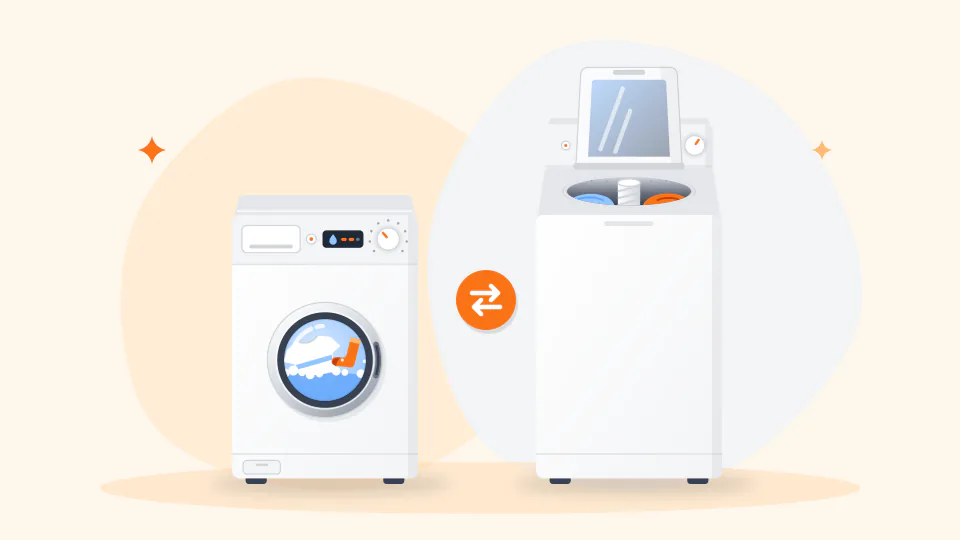
A front loader has a drum lying on its side. As it turns, paddles lift the clothes and drop them back into a shallow pool of water and detergent, so the tumbling does the cleaning.
A top loader has an upright drum that fills with more water. It moves the clothes either with an agitator, a central post that twists back and forth, or with a pulsator (also called an impeller), a low disc at the bottom that sets the water swirling. Agitators are vigorous; pulsator models are gentler and leave more room in the drum.
Cleaning and fabric care
Front loaders generally give the most thorough wash with the least wear on clothes, because tumbling cleans without twisting the fabric. Nearly all of them heat their own water, so you can choose 30°C, 40°C, 60°C or hotter for towels, bedding and hygiene washes.
Top loaders do a good job on everyday loads, and agitator models handle heavily soiled work clothes well, but they can tangle and stretch delicate items. Many top loaders have no built-in heater. They wash in cold water, or with hot water from your geyser if they have a hot-water inlet and it’s connected. If your laundry only has a cold tap, check this before you buy.
Detergent makes a difference
A front loader needs low-suds detergent for automatic machines, usually marked “auto” on the pack, and a smaller dose than most people expect. Hand-wash powder, or too much of any detergent, causes excess foam, poor rinsing and residue, and residue leads to smells. Top loaders use more water and are more forgiving, but the dose on the pack still applies. If a front loader has started to smell, read why your washing machine smells.
Running costs and buying price
Water and spin speed
Front loaders use much less water per load, which helps during water restrictions and outages, and if you pay for water by volume. They also spin faster, typically 1,000 to 1,400 rpm against around 700 to 800 rpm for many top loaders, so clothes come out drier and spend less time on the line or in a tumble dryer.
Electricity
Electricity is less clear-cut. A front loader heats its own water with an element, and heating is the biggest use of power in any hot wash. A top loader filling with hot water from the geyser simply moves that cost to the geyser. On cold and eco programmes, both types are cheap to run. Washing machines sold in South Africa must carry the energy efficiency label, so compare the labels, and the water use per cycle where the manufacturer gives it, for the models on your list.
Buying price
Prices overlap a lot between the two types, so compare machines of similar capacity and features rather than front against top in general. Look past the price tag, too: water use, spin speed (which affects drying time) and whether there’s a heater all shape what the machine costs you over its life.
Cycle times and power cuts
Front loader programmes are long. A standard cotton wash often takes two hours or more, and eco programmes take longer still, because they save energy by washing slowly at a lower temperature. Most have a quick programme for lightly soiled loads.
Top loader cycles are usually much shorter, which helps if your area has power cuts or you run the machine on backup power. Power cuts, surges and inverters are covered in how to protect your washing machine from load shedding.
Space and installation
Front loaders fit under a kitchen counter, and on many models you can stack a tumble dryer on top with the right stacking kit. They need room in front for the door to swing open and for you to kneel while loading. A top loader’s lid opens upwards, so it needs headroom and can’t sit under a counter, though it needs less space in front.
Integrated front loaders and washer-dryers sit behind a cabinet door, which suits apartments and smaller kitchens. They save space but take a little longer to repair, because they have to be eased out of the cabinetry first.
Fast spins also make demands on the floor. A front loader needs a solid, level base, and on a suspended wooden floor or an upstairs laundry, careful levelling matters even more. Whichever type you choose, the transit bolts must come out and the drain must be set up correctly. Our washing machine installation service takes care of both.
Everyday ease of use
Top loaders win on comfort: there’s no bending, and on most models you can lift the lid and add an item mid-wash. Front loaders lock the door during the wash, though many let you pause and add something early in the cycle, while the water level and temperature still allow the door to unlock. If bending is a problem, a pedestal made for your model raises a front loader to a kinder height.
What tends to go wrong
Both types share some faults, such as drain pump blockages from coins and hair clips, and failed inlet valves that leave a machine not filling with water. Beyond those, each type has its own wear points.
Front loaders
- Door locks and door seals (see washing machine door won’t open)
- Drum bearings and shaft seals on well-used machines (see signs of worn bearings)
- Carbon brushes on machines with brushed motors
- Heating elements and shock absorbers
Top loaders
- Lid switches and lid locks
- Drive belts, couplings, clutches and gearboxes
- Suspension rods, which let the machine bang and walk on spin as they wear (see washing machine noisy when spinning)
Neither type is clearly more reliable. Build quality varies far more between brands, models and price points than between front and top loaders. Many top loader repairs are fairly simple, while a bearing replacement on a front loader is a big job, and on a sealed tub it can be costly. Washer-dryers add a drying system, so they have more parts that can wear; our washer dryer repairs page explains what’s involved. For the repairs themselves, see front loader repairs and top loader repairs.
Which suits your household?
| If you… | Consider |
|---|---|
| Want the lowest water use | Front loader |
| Need it under a counter, or want to stack a dryer | Front loader |
| Wash towels and bedding hot but only have a cold tap | Front loader (built-in heater) |
| Want short cycles around power cuts | Top loader |
| Find bending difficult | Top loader, or a front loader on a pedestal |
| Run several heavy family loads a day | Either: choose a robust, large-capacity model |
| Want washing and drying in one machine | Washer-dryer (front loading) |
Questions to ask before you buy
- What capacity do you need? The kilogram rating is the maximum dry load on the cotton programme; synthetics and delicates programmes take much less, often about half. Choose a size that takes your usual load without packing the drum tight.
- Does it suit your plumbing? Check whether it fills from cold only or has a hot-water inlet, and that the drain hose will reach your standpipe or sink waste at the height the manual gives.
- Will it fit with the door or lid open? Measure the space, the clearance for the door or lid, and the doorways on the way in.
- How fast does it spin? A higher spin speed means drier clothes and shorter drying times.
- How loud is it? If the machine will stand near bedrooms or in an open-plan living area, compare the spin noise figures on the specification sheets where they’re given.
- What kind of motor does it have? Many newer machines of both types use a brushless inverter motor, which tends to run quietly and has no carbon brushes to wear out.
The bottom line
Front loaders use less water, spin faster and treat clothes more gently. Top loaders are quicker, easier to load and often simpler to repair. Either can serve you well for many years if it’s installed properly, loaded sensibly and kept clean. If you’re deciding whether to replace a broken machine at all, read our repair or replace guide first.
Need your current machine fixed, or a new one installed? Call or WhatsApp ProServ on 079 895 0496 or book online. We repair front loaders and top loaders from all major washing machine brands.